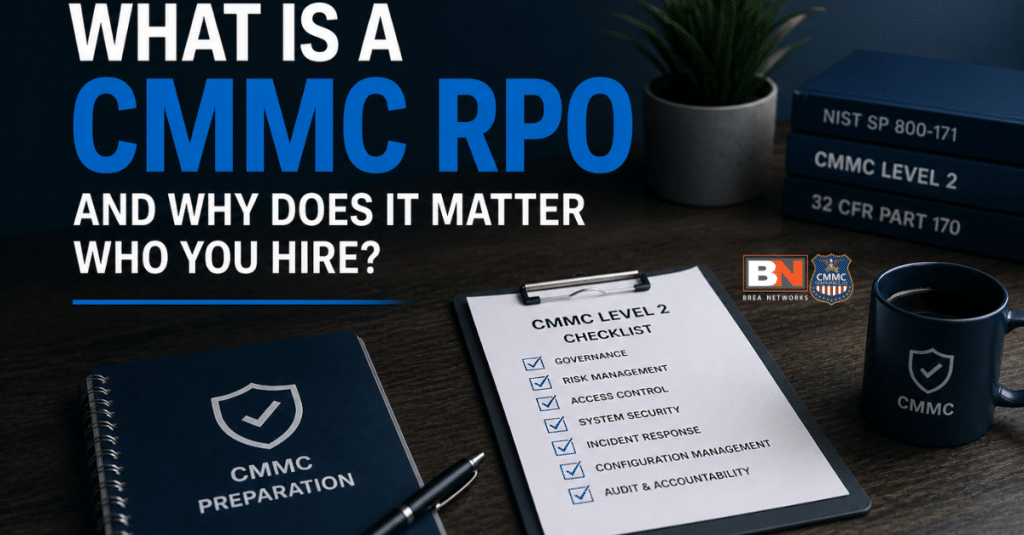
Every defense contractor working toward CMMC Level 2 eventually hits the same wall. The regulations are dense, the technical requirements are specific, and the gap between where an organization is and where it needs to be for a C3PAO assessment is rarely small. At that point, most organizations start looking for outside help.
That is where the RPO comes in. But the term is thrown around loosely enough in the compliance market that many contractors hire someone calling themselves a CMMC consultant without understanding what that designation actually means, what it does not guarantee, and why the distinction matters before spending tens of thousands of dollars preparing for an assessment they may not pass.
The CMMC Ecosystem Has Defined Roles for a Reason
The Cyber AB the accreditation body that oversees the CMMC certification ecosystem, has established a tiered structure of roles that separates the organizations that help contractors prepare from the organizations that assess them.
At the assessment level sits the Certified Third-Party Assessment Organization (C3PAO). C3PAOs conduct the formal assessments that result in CMMC Level 2 certification. Assessment procedures and reporting requirements are defined in the official CMMC Assessment Process (CAP) and the DoW’s CMMC Assessment Guide Level 2.
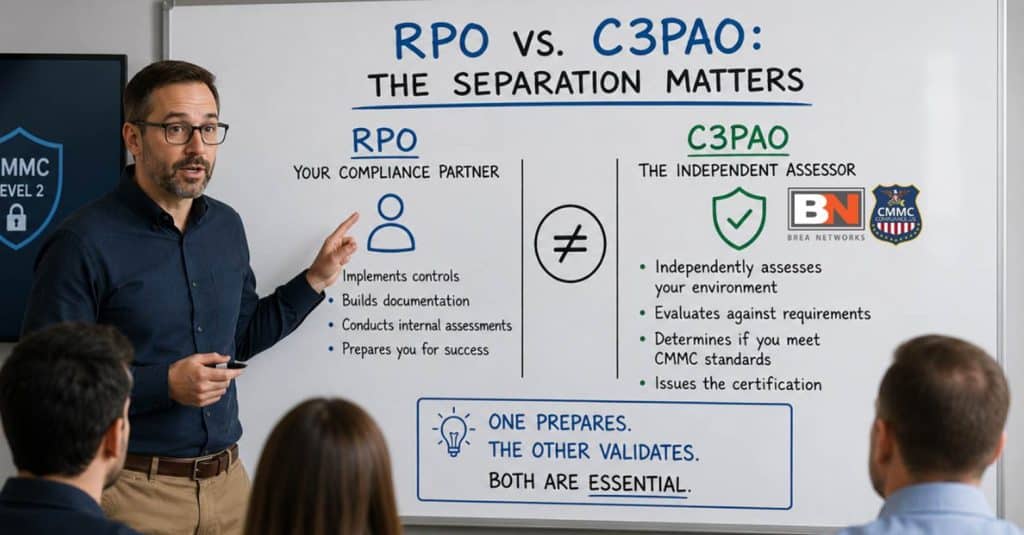
Below that, on the consulting and implementation side, sits the Registered Practitioner Organization (RPO). RPOs deliver advisory and implementation support through individuals holding Registered Practitioner designations issued by the Cyber AB. Unlike C3PAOs, RPOs do not conduct certified CMMC assessments. This separation exists intentionally to avoid conflicts of interest within the certification ecosystem.
What an RPO Actually Does
An RPO typically assists organizations throughout the pre-assessment process. This includes conducting gap assessments against the 110 security requirements in NIST SP 800-171 Revision 2, identifying missing or partially implemented controls, helping define the CMMC assessment scope using the official CMMC Scoping Guide Level 2, assisting with development of the System Security Plan, building evidence libraries aligned to the 320 assessment objectives in the CMMC Level 2 Assessment Guide, supporting remediation activities and allowable POA&M management under 32 CFR § 170.21, and preparing organizations for interviews, testing, and evidence review during assessment.
Some RPOs also operate as Managed Service Providers, implementing the technical infrastructure necessary to satisfy CMMC requirements. This includes Microsoft 365 GCC High environments, multifactor authentication, endpoint detection and response, centralized logging and monitoring, and secure enclaves for Controlled Unclassified Information.
How an Organization Becomes an RPO
To become an RPO, an organization must register with the Cyber AB and meet administrative requirements established by the accreditation body. These include associating at least one active Registered Practitioner with the organization, passing organizational vetting requirements, signing applicable agreements and codes of conduct, and maintaining annual registration status.
Individual practitioners within an RPO may hold the designation of Registered Practitioner (RP) or Registered Practitioner Advanced (RPA). The Cyber AB Marketplace allows contractors to verify whether an organization currently maintains active RPO status before engaging them.
RPO vs. C3PAO: The Separation Matters
One of the most important rules in the CMMC ecosystem is the separation between implementation support and certification assessment. An organization that helps implement your controls generally cannot also certify those same controls. This is designed to preserve assessment integrity and avoid conflicts of interest under 32 CFR § 170.9.
That distinction matters because many contractors mistakenly assume that hiring an RPO guarantees certification, that hiring a consultant is equivalent to hiring an assessor, or that achieving CMMC readiness automatically means assessment success. None of those assumptions are true.
An RPO helps prepare your organization for assessment. Only an accredited C3PAO can perform a Level 2 certification assessment under 32 CFR § 170.17, and only the DCMA Defense Industrial Base Cybersecurity Assessment Center (DIBCAC) performs Level 3 assessments under the current CMMC framework.

Not sure where your organization stands with CMMC, ITAR, or federal cybersecurity requirements? The fastest way to get clarity is to talk with an expert. Book a call with our team to review your current environment, identify compliance risks, and understand what steps are required to move forward. A short conversation can help you avoid costly mistakes and focus on what matters for contract eligibility and security.
SCHEDULE YOUR FREE CONSULTATION!
Why Contractor Selection Matters
Not all RPOs operate at the same level of technical depth. Some focus primarily on documentation and policy templates. Others specialize in architecture design, enclave engineering, Microsoft GCC High migrations, SIEM deployment, or incident response maturity.
Because Level 2 assessments evaluate whether controls are implemented correctly, operating as intended, and producing the desired security outcome, organizations should evaluate RPOs based on actual implementation experience not just marketplace registration status.
The DoW’s official CMMC documentation makes clear that Level 2 certification assessments are based on evidence, interviews, examination, and testing not simply policy existence alone. The two primary documents governing how assessments are conducted are the CMMC Assessment Guide Level 2 and the CMMC Assessment Process (CAP).
Understanding what those documents require before selecting an RPO is the most direct way to evaluate whether a given firm has the depth to prepare your organization for what a C3PAO will actually look for on assessment day.
Questions to Ask Before You Sign
Before engaging any firm for CMMC preparation work, verify their active RPO status in the Cyber AB Marketplace. Ask which individual practitioners hold current RP or RPA designations and confirm those names appear in the marketplace listing. Ask whether the firm has prepared organizations that have subsequently passed a C3PAO assessment, and ask for their approach to CUI scoping under 32 CFR § 170.19 before remediation work begins. Scoping determines cost. An RPO that cannot explain it clearly before engagement is one that will cost you more later.
The CMMC ecosystem intentionally separates consulting from certification. Understanding that separation is critical before engaging outside support.
A qualified RPO can significantly reduce the time, cost, and confusion involved in preparing for a CMMC assessment. But an RPO is not a certifying body, and registration alone does not guarantee implementation quality. The certification comes from a C3PAO and only from a C3PAO. What an RPO provides is the preparation that makes that certification achievable on the first attempt.
With the Phase 2 deadline of November 10, 2026 approaching and C3PAO queues filling fast, the decision of who to hire for preparation work is not a minor procurement decision. It is the first compliance decision your organization makes and the one that shapes every outcome that follows.
If your organization supports defense contracts and is unsure how CMMC timelines, SPRS requirements, or assessment readiness apply to you, now is the time to get clarity.
About Brea Networks
Brea Networks is a cybersecurity and compliance-focused IT partner dedicated to supporting Defense Industrial Base (DIB) contractors. We help organizations understand and implement the security requirements outlined in FAR 52.204-21, DFARS 252.204-7012, and the CMMC framework. From Level 1 self-assessments to Level 2 readiness and certification preparation, our team works alongside contractors to strengthen system security, define scope, prepare documentation, and build sustainable compliance programs that protect FCI and CUI.