On June 23, 2026, the Federal Acquisition Regulatory Council published a proposed rule in the Federal Register that would amend multiple parts of the Federal Acquisition Regulation. This post explains what the proposal covers, what it does not change, and what defense contractors and compliance professionals should do right now.
Editorial note: All claims in this post are sourced directly from the proposed rule published at 91 FR 37550, FAR Case 2026-001, June 23, 2026. Page references from the Federal Register are provided for each major claim. Contractors should review the full Federal Register notice and consult qualified legal counsel regarding the impact on specific contracts. This is a proposed rule. No changes are in effect.
At CMMCCompliance.US, we are publishing this post because our clients and employees need to understand what this proposed rule is, what it proposes to change, what it does not change yet, and what it means for contracts, compliance obligations, and business operations in the Defense Industrial Base.
What You Need to Know at a Glance
| Category | Status |
| Proposed rule published | June 23, 2026 |
| Federal Register citation | 91 FR 37550, FAR Case 2026-001 |
| Public comment deadline | July 23, 2026 |
| Rule effective | Not yet this is a proposal only |
| Current FAR requirements | Unchanged until a final rule is published |
| CMMC Phase 2 deadline | Unchanged November 10, 2026 |
| DFARS cybersecurity clauses | Unchanged at this time |
| SPRS submission requirements | Unchanged at this time |
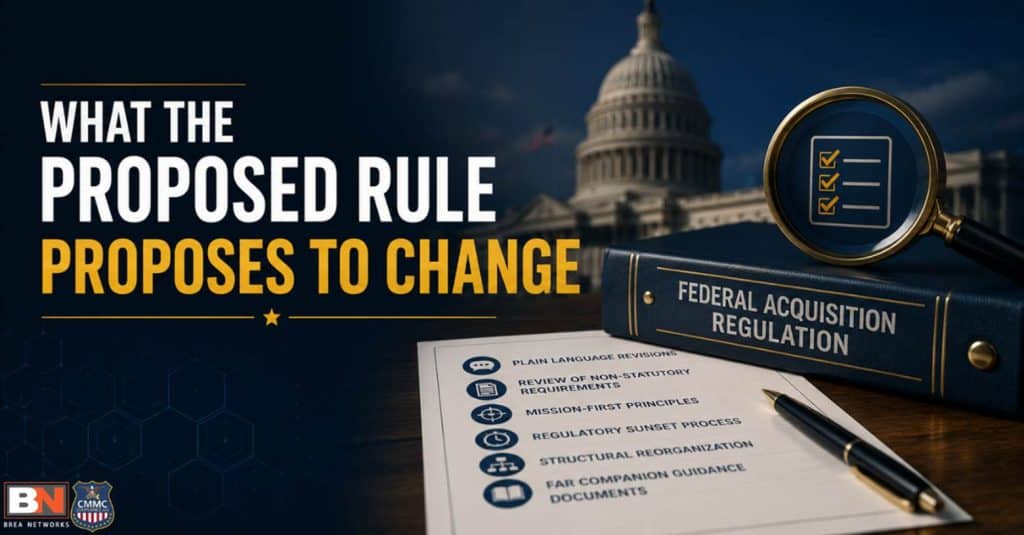
Proposed changes: Structural reorganization, plain language revisions, non-statutory requirement review, regulatory sunset process, FAR Companion guidance documents.
Effective changes: None. This is a proposed rule.
No-change items: CMMC Level 2 certification requirements, DFARS 252.204-7012, DFARS 252.204-7021, SPRS submission obligations, NIST SP 800-171 assessment requirements, and Phase 2 enforcement deadline of November 10, 2026.
What the Proposed Rule Is
The Federal Acquisition Regulatory Council, consisting of the Office of Federal Procurement Policy, the Department of War, the General Services Administration, and NASA, published FAR Case 2026-001 on June 23, 2026, at 91 FR 37550. The proposal implements Executive Order 14275, Restoring Common Sense to Federal Procurement, April 15, 2025, which directed the FAR Council to produce a streamlined FAR containing only provisions required by statute or essential to sound procurement.
To implement Executive Order 14275, the Office of Management and Budget issued Memorandum M-25-26, Overhauling the Federal Acquisition Regulation, which announced the overhaul initiative and created a roadmap for producing simpler regulations aligned to statute, rewritten in plain language.
According to the proposed rule at 91 FR 37550, the FAR Council is issuing twelve proposed rules that collectively propose to streamline the FAR in its entirety. This specific proposed rule covers proposed revisions to FAR Parts 1, 2, 4, 33, 39, 40, 52, and 53.
What the Proposed Rule Proposes to Change
All items below are proposals sourced from 91 FR 37550. None has taken effect. Page references from the Federal Register PDF are provided for each item.
Plain language revisions (91 FR 37550-37551). The proposed rule states that FAR parts are to be reorganized into acquisition phases, with text simplified into plain language where possible, including changes to active voice and reorganization to present information more logically. The proposed rule explicitly states that none of the plain language edits are intended to change existing FAR requirements. Contractors should not interpret stylistic and drafting revisions as substantive changes to their obligations. That distinction is clearly stated in the proposal itself and should be verified in any final rule before any changes to compliance programs are made.
Replacement of “shall” with “must” (91 FR 37551). The proposed rule proposes to replace the term “shall” with “must” or “will” throughout the FAR text, provisions, and clauses. According to the proposal, this is a drafting change consistent with plain language standards and does not alter the substance of any existing requirement. Contractors and legal counsel should verify this characterization against specific clause language in any final rule before concluding that no substantive change has occurred.
Review and reduction of non-statutory requirements (91 FR 37551). According to the proposed rule, the FAR Council reviewed all non-statutory requirements against the criteria in Section 4 of Executive Order 14275. Requirements that did not meet the standard of being required by statute or necessary to support simplicity, strengthen the procurement system, or protect economic or national security were removed from the regulation. The proposed rule states that non-statutory requirements that were beneficial but not essential were retained in non-regulatory guidance documents, and other non-statutory requirements that did not meet those standards were removed entirely.
Mission-first guiding principles, FAR 1.102 (91 FR 37551). According to the proposed rule, revisions to FAR 1.102 prioritize a mission-first approach as the paramount principle of the Federal Acquisition Regulations System. The proposal states the guiding principles also elevate fiscal responsibility, prioritize the best use of taxpayer dollars, including price preferences and incentives for domestically sourced goods and services, and continue to promote competition and innovation.
Regulatory sunset process, FAR Part 1 (91 FR 37551-37552). According to the proposed rule, consistent with Section 6 of Executive Order 14275, the proposal adds a new regulatory sunset requirement to the FAR establishing a process to review sections, provisions, and clauses and identify those that are no longer required or are outdated. The proposed rule states that sections, provisions, and clauses do not expire until removed from the Code of Federal Regulations through rulemaking unless an expiration date is otherwise specified. This is a structural addition to the FAR with long-term implications for how regulatory requirements are maintained and retired.
Forms centralized online, FAR Part 1 and Part 53 (91 FR 37552). According to the proposed rule, all information pertaining to forms is proposed to be relocated from FAR Part 53 to FAR Part 1, subpart 1.6. A centralized website at acquisition.gov/FARforms would serve as the authoritative repository for all acquisition-related forms, allowing the forms list to be updated without formal rulemaking.
FAR Companion (91 FR 37551). According to the proposed rule, the FAR Council has created non-regulatory resources, including the FAR Companion, which provides guidance from experienced practitioners on streamlined practices. The proposed rule states that requirements previously in the FAR that were procedural rather than statutory in nature are being moved to the FAR Companion and similar guidance documents. Content in the FAR Companion is non-regulatory and advisory, not binding. The FAR Companion is referenced in the proposed rule, but a standalone public URL has not yet been confirmed. Contractors should understand the difference between requirements in the FAR itself and guidance in the FAR Companion when any final rule takes effect.
Potential Benefits if Finalized
Based on the proposal as written, if the final rule substantially follows the proposed rule, the following outcomes may benefit defense contractors.
Reduced compliance burden from non-statutory procedural requirements that are moved to advisory guidance rather than mandatory regulation. Contracting officers may have more discretion to apply policies in ways appropriate to specific situations rather than following rigid procedural mandates.
Improved readability of FAR clauses due to plain language revisions, active voice changes, and logical reorganization. Contractors negotiating and performing contracts with complex clause structures may find the revised text clearer to interpret.
A formal regulatory sunset process that creates a mechanism for outdated requirements to be retired through rulemaking rather than accumulating indefinitely. Over time, this may reduce the volume of clauses that apply to contracts without serving a current purpose.
A centralized forms repository at acquisition.gov/FARforms that reduces confusion about which form versions are current and simplifies access to acquisition-related forms.

Not sure where your organization stands with CMMC, ITAR, or federal cybersecurity requirements? The fastest way to get clarity is to talk with an expert. Book a call with our team to review your current environment, identify compliance risks, and determine the steps required to move forward. A short conversation can help you avoid costly mistakes and focus on what matters for contract eligibility and security.
SCHEDULE YOUR FREE CONSULTATION!
Potential Risks if Finalized
The same changes also carry risks that contractors should monitor.
If finalized as proposed, some content currently appearing in the FAR would be relocated to advisory guidance documents such as the FAR Companion. For contractors, this may create uncertainty about what is actually required on a given contract versus what guidance is, and contracting officers will have more discretion to determine how and whether to apply advisory provisions.
The regulatory sunset process, while potentially beneficial for reducing outdated requirements, also creates a mechanism by which requirements that contractors have built compliance programs around could be removed or modified over time. Contractors with compliance programs tied to specific FAR provisions should monitor sunset proceedings as they are initiated through future proposed rules.
The broad non-statutory requirement review means that some procedural protections that currently exist in the FAR may be reduced or eliminated in the final rule. The proposal states that requirements removed from the FAR that were beneficial but not essential were moved to non-regulatory guidance, but non-regulatory guidance is not enforceable in the same way as a binding regulation.
Questions That Cannot Yet Be Answered
In the interest of presenting this proposal accurately, the following questions remain open and cannot be answered by the proposed rule alone.
How much of the proposal survives the public comment process? The FAR Council is required to consider substantive public comments received before July 23, 2026. The final rule may differ materially from the proposed rule depending on the volume and content of industry feedback. No assumptions about the final rule should be made based on the proposal as published at 91 FR 37550.
Will agencies issue supplemental guidance? Federal agencies, including the DoW, may issue agency-specific guidance that supplements or interprets the final rule once it is published. The interaction between any final FAR changes and existing DoW-specific DFARS clauses and CMMC requirements governed by 32 CFR Part 170 will need to be analyzed once that guidance is available.
How will courts and boards treat FAR Companion materials? The FAR Companion is proposed as non-regulatory guidance. Courts, boards of contract appeals, and contracting officers may treat FAR Companion materials differently from binding FAR provisions. The legal weight of FAR Companion guidance in disputes has not been established and will likely be developed through case law and agency practice over time.
Will proposed changes to FAR Parts 39 and 40 affect future cybersecurity clauses? FAR Parts 39 and 40 address information technology and telecommunications. The specific effect of any final rule changes to those parts on future cybersecurity-related solicitation language, including how those changes interact with DFARS 252.204-7012 and DFARS 252.204-7021, cannot be determined from the proposed rule alone.
Will CMMC rulemaking be affected? The CMMC program rule at 32 CFR Part 170 is a DoW regulation separate from the FAR. Whether any final FAR changes create downstream pressure for CMMC rulemaking updates is unknown at this time.
What This Means for CMMC Compliance Right Now
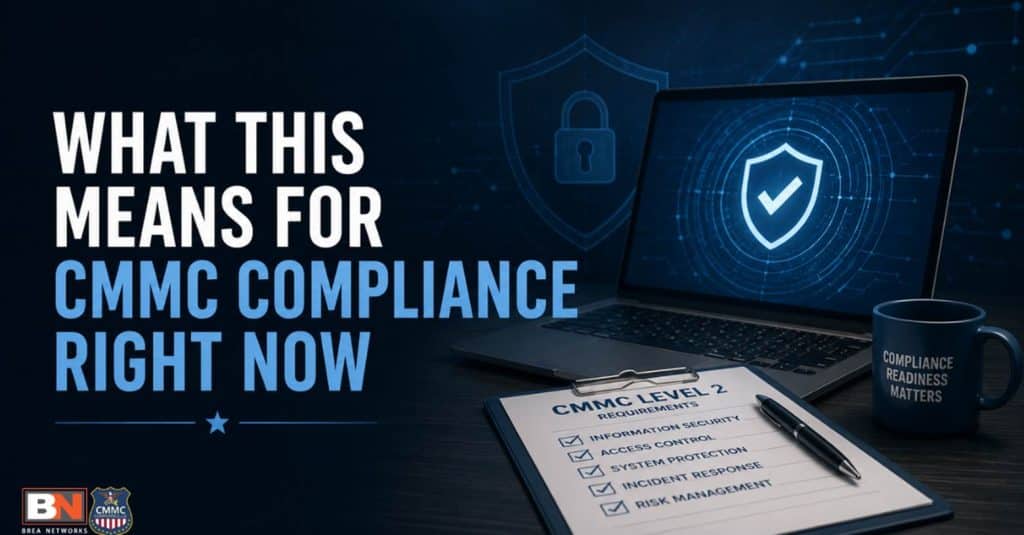
CMMC is governed by 32 CFR Part 170, a DoW regulation finalized independently of the FAR. The CMMC program rule, the DFARS clauses that implement CMMC in contracts, and the NIST SP 800-171 assessment requirements are separate from the FAR amendments being proposed.
Based on the current proposal, the Phase 2 CMMC enforcement deadline of November 10, 2026, is unchanged. Self-assessment obligations, SPRS submission requirements, C3PAO certification requirements under 32 CFR § 170.17, and annual affirmation obligations under 32 CFR § 170.22 are unchanged by this proposed rule.
The proposed rule includes changes to FAR Parts 39 and 40, which address information technology and telecommunications. The specific implications of the proposed changes to those parts for defense cybersecurity requirements will depend on what the final rule contains after the comment period. We will publish the analysis as those details become clear.
For now, CMMC compliance timelines and obligations remain unchanged from before June 23, 2026.
What Contractors Should Do Right Now
1. Read the proposed rule. The full text is 85 pages and is publicly available at no cost through the Federal Register and as a PDF through GovInfo. Contractors with specific concerns about FAR Parts 1, 2, 4, 33, 39, 40, 52, or 53 should review the proposed text against their current contracts.
2. Identify which FAR parts apply to your contracts. Not every proposed change affects every contractor in the same way. Review current contracts to understand which FAR clauses are incorporated and whether any of the proposed changes to the relevant parts affect those clauses specifically. The current FAR is available at acquisition.gov.
3. Consult qualified legal counsel. The interaction between proposed FAR changes, existing contract terms, DFARS clauses, and CMMC obligations involves legal questions that require professional analysis. Do not make changes to the compliance program based on a proposed rule without legal review.
4. Submit public comments before July 23, 2026 if you have substantive concerns. Comments in response to FAR Case 2026-001 must be submitted through Regulations.gov by July 23, 2026, citing FAR Case 2026-001. The FAR Case 2026-001 Docket contains background documents and previously submitted comments. For questions about content, contact FARpolicy@gsa.gov.
5. Continue CMMC compliance work without interruption. This proposed rule does not change CMMC obligations. The November 10, 2026, Phase 2 deadline remains in place under 32 CFR Part 170. If your organization has not yet completed a gap assessment, submitted an SPRS score, or engaged a C3PAO, those actions remain the most immediate compliance priority.
6. Monitor for the final rule. The final rule will be published in the Federal Register after the public comment period closes and the FAR Council has reviewed submissions. Until the final rule is published, no changes take effect. Subscribe to Federal Register notifications for FAR Case 2026-001 at Regulations.gov to receive updates automatically.
The Bottom Line
The June 23, 2026, proposed rule proposes structural and stylistic changes to multiple parts of the Federal Acquisition Regulation, driven by Executive Order 14275 and implemented through OMB Memorandum M-25-26. The proposal is part of a broader effort to streamline federal procurement regulations and move procedural guidance out of binding regulatory text and into advisory companion documents.
Based on the current proposal, no changes are in effect. Current contracts, CMMC obligations, and DFARS requirements are governed by existing rules. If finalized substantially as proposed, the rule may reduce procedural compliance burden while also shifting some previously mandatory requirements to advisory guidance, with implications for how contracts are interpreted and enforced that will need to be analyzed once a final rule is published.
Understanding what is being proposed, clearly distinguishing it from what is currently required, and monitoring the rulemaking process through to finalization are the most practical actions available right now. The comment period closes July 23, 2026. That window is the formal opportunity to shape the final rule. After it closes, the industry no longer participates in the rulemaking process.
If your organization supports defense contracts and is unsure how CMMC timelines, SPRS requirements, or assessment readiness apply to you, now is the time to get clarity.
About Brea Networks
Brea Networks is a cybersecurity and compliance-focused IT partner dedicated to supporting Defense Industrial Base (DIB) contractors. We help organizations understand and implement the security requirements outlined in FAR 52.204-21, DFARS 252.204-7012, and the CMMC framework. From Level 1 self-assessments to Level 2 readiness and certification preparation, our team works alongside contractors to strengthen system security, define scope, prepare documentation, and build sustainable compliance programs that protect FCI and CUI.
What Changes: The Affirmation Requirement. The annual affirmation requirement applies at Level 3 just as it does at Level 2. Under 32 CFR § 170.22, a senior company official must submit an annual affirmation in SPRS confirming continued compliance within the CMMC Assessment Scope. Given that Level 3 status also satisfies Level 1 and Level 2 status requirements for the same scope, the annual affirmation at Level 3 covers the full body of requirements across all three levels.