For many defense contractors, the most stressful part of CMMC is not the preparation. It is the thought of going through everything, the months of work, the documentation, the remediation, the scheduling, and still not passing.
It is a legitimate concern. And it deserves a straight answer.
The short version is this: an assessment that does not result in certification is not the end of your defense contracting career. It is not a permanent mark against your organization. What it does is prevent award eligibility for contracts requiring that CMMC status until deficiencies are remediated. Understanding exactly what that means, what the official outcomes are, and what your path forward looks like is what this post is designed to explain.
The Three Official Outcomes of a Level 2 Certification Assessment
When a C3PAO conducts a Level 2 certification assessment under 32 CFR § 170.17, assessors evaluate your organization against all 110 security requirements in NIST SP 800-171 Revision 2 and the associated assessment objectives defined in the DoW CIO CMMC Assessment Guide Level 2. Each objective is determined to be either MET or NOT MET based on a review of documentation, interviews with your personnel, and technical testing of your controls.
At the end of that process, the CMMC Assessment Process (CAP) v2.0 defines three possible outcomes. The CAP applies specifically to CMMC Level 2 certification assessments and must be used in conjunction with 32 CFR Part 170 and related DoW guidance.
Final Level 2. If all Level 2 requirements are determined to be MET, the assessment results recommend issuance of a Final Level 2 Certificate of CMMC Status. That certification is recorded in SPRS and is valid for three years, with annual affirmations required under 32 CFR § 170.22.
Conditional Level 2. If all requirements are MET except for those eligible for a valid Plan of Action and Milestones under 32 CFR § 170.21, the assessment results recommend issuance of a Conditional Level 2 Certificate of CMMC Status. Conditional status comes with defined remediation requirements and a 180-day closeout deadline.
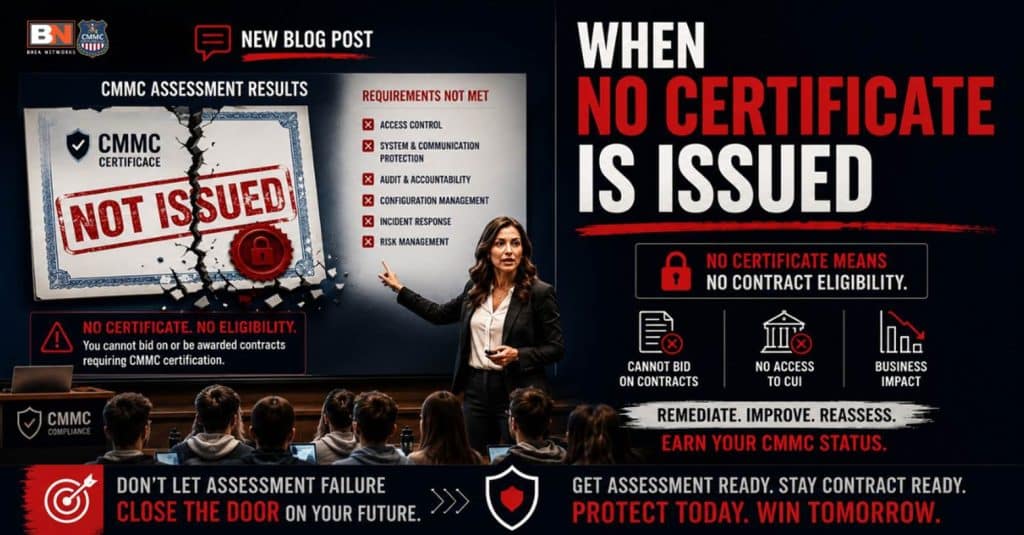
No Certificate Issued. If the requirements are NOT MET and a valid POA&M cannot be attained under the criteria in 32 CFR § 170.21, the assessment results recommend against issuing a Level 2 Certificate of CMMC Status. The organization must remediate deficiencies and successfully complete a subsequent assessment before achieving the required CMMC Status.
Those are the three outcomes as defined in the official CMMC framework. Everything else in this post flows from understanding what each one means in practice.

Not sure where your organization stands with CMMC, ITAR, or federal cybersecurity requirements? The fastest way to get clarity is to talk with an expert. Book a call with our team to review your current environment, identify compliance risks, and understand what steps are required to move forward. A short conversation can help you avoid costly mistakes and focus on what matters for contract eligibility and security.
SCHEDULE YOUR FREE CONSULTATION!
Conditional Level 2: What It Covers and What It Does Not
Conditional Level 2 status exists to give organizations a structured path when deficiencies remain but qualify for remediation under defined rules. Understanding those rules clearly is important because the conditional status is more limited than it is sometimes understood to be.
Under 32 CFR § 170.21, an organization may achieve Conditional Level 2 status only if it achieves the minimum passing score defined in the scoring methodology at 32 CFR § 170.24, includes only permissible items in the POA&M, and commits to remediating all POA&M items within 180 days of the Conditional Status Date.
Not every NOT MET requirement is eligible for POA&M. The regulation identifies specific requirements that cannot be deferred; those requirements must be fully implemented before the assessment concludes. If those requirements are not met, Conditional status is not available regardless of overall score.
The 180-day closeout window is firm. During that period, your organization implements the remaining controls, collects supporting evidence, and requests a POA&M closeout assessment from the C3PAO. If the closeout assessment confirms all requirements are now MET, your status upgrades to Final Level 2. If the 180-day period passes without a successful closeout assessment, the Conditional Level 2 status expires. At that point, under 32 CFR § 170.17, the organization becomes ineligible for additional awards requiring Level 2 (C3PAO) status until a new assessment is completed and a new CMMC Status is achieved.
When No Certificate Is Issued
When requirements are NOT MET and a valid POA&M is not attainable, the assessment concludes without a certificate being issued. The assessment produces a documented record of findings identifying which requirements were NOT MET and the basis for each determination.
The organization must remediate deficiencies and successfully complete a subsequent assessment before achieving the required CMMC Status. The findings from the prior assessment identify exactly where work is needed, which requirements were not met, and what the assessors observed during examination, interview, and testing. Remediation work is guided by those specific findings, by the DoW CIO CMMC Assessment Guide Level 2, and by the DoW CIO CMMC Scoping Guide Level 2.
One area the official guidance places particular emphasis on is assessment scope. Under 32 CFR § 170.19 and the CMMC Scoping Guide Level 2, scope validation is a required activity during the assessment process. The assessment boundary defines which assets are evaluated: CUI Assets, Security Protection Assets, Contractor Risk Managed Assets, Specialized Assets, and Out-of-Scope Assets, each of which carries different assessment requirements. Scoping errors that leave systems handling Controlled Unclassified Information outside the defined boundary are identified during the assessment and affect the findings record.
Getting scope right before engaging a C3PAO is not optional. The CMMC Assessment Guide Level 2 is publicly available and describes exactly what assessors evaluate against each assessment objective. Reviewing it carefully before an assessment and evaluating your own environment honestly against what it describes is the most direct way to understand whether your organization is ready.
The Contract Eligibility Consequences
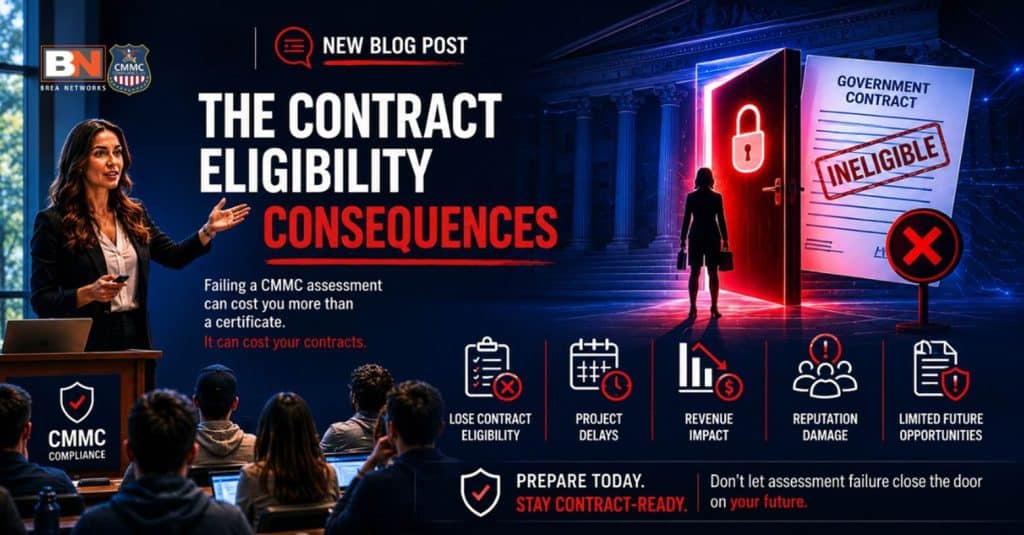
Under DFARS 252.204-7021, contractors must maintain the CMMC status required for their contract for the entire period of performance. If your contract requires Level 2 C3PAO certification and you have not achieved it, you are not eligible for the award. If your Conditional status expires during contract performance, the organization may be subject to contractual remedies in accordance with applicable contract terms and DoW requirements, and you become ineligible for additional awards requiring that CMMC status until a new certification is achieved.
For subcontractors, the flow-down obligation under 32 CFR § 170.23 means the same requirements apply based on the type of information handled, regardless of supply chain position. Prime contractors verify SPRS records and compliance documentation as part of their own contract obligations, because their eligibility depends in part on the compliance posture of the organizations supporting them.
Your SPRS record reflects your current CMMC Status. Contracting officers and primes check it. Keeping it accurate and current is a direct business requirement, not only a compliance one.
Level 3: An Additional Layer
For organizations pursuing CMMC Level 3, the official framework under 32 CFR § 170.18 requires that a Final Level 2 (C3PAO) certification already be in place before a Level 3 assessment can be initiated. Level 3 assessments are conducted by DCMA DIBCAC rather than a private-sector C3PAO, reflecting the elevated sensitivity of the programs involved. They evaluate compliance with selected requirements from NIST SP 800-172, as well as all requirements at Level 2.
Conditional Level 2 status does not satisfy the Level 3 prerequisite. Final Level 2 is required. An organization that holds Conditional status must close its POA&M and achieve Final Level 2 before DIBCAC assessment scheduling is available.
What Helps Most Before an Assessment
The CMMC Assessment Guide Level 2 and the CMMC Scoping Guide Level 2 together describe exactly what assessors evaluate and how assessment scope is defined. Both documents are publicly available at no cost through the DoW CIO CMMC Documentation page.
Working through both documents against your actual environment before engaging a C3PAO allows your organization to identify gaps on your own timeline and address them before the formal assessment begins. The CMMC Assessment Process (CAP) v2.0 describes how the assessment engagement itself is structured, what happens during each phase, and how findings are documented and reported.
Your System Security Plan must describe how your organization implements each of the 110 security requirements across all assets within your assessment scope. It must reflect your actual environment at the time of assessment. Under NIST SP 800-171 Revision 2, organizations are required to develop, document, and periodically update their SSP to reflect system boundaries, operating environments, implemented security requirements, and system relationships.
Evidence that supports each assessment objective needs to be organized and accessible. Assessors use examine, interview, and test methods to evaluate every objective. Documentation that accurately reflects implemented controls, personnel who can speak to the processes they are responsible for, and technical configurations that work as the SSP says they work are the three factors that determine whether each objective is MET.
A Path Forward From Any Outcome
If your assessment results in Final Level 2, your certification is on record in SPRS, your Certificate of CMMC Status is issued, and your focus shifts to maintaining compliance through annual affirmations under 32 CFR § 170.22 and a reassessment in three years.
If your assessment results in Conditional Level 2, your 180-day clock starts immediately. The path forward is defined: implement the remaining controls, collect evidence, and schedule your closeout assessment well before the deadline. Organizations that begin closeout work immediately after Conditional status is awarded are in a significantly better position than those that wait.
If your assessment results in no certificate being issued, the path forward begins with a thorough review of the assessment findings against the CMMC Assessment Guide Level 2. The findings are specific. The guide describes what MET looks like for each objective. Working from that documentation, in the order that addresses the most significant gaps first, is the most direct route to a successful subsequent assessment.
Final Thought
The CMMC assessment process is designed to produce a clear, documented outcome, one of three defined results, each with a defined path forward. None of those outcomes is permanent. Final Level 2 is valid for three years. Conditional Level 2 has a 180-day remediation path. No certificate issued means remediation and a subsequent assessment.
The applicable requirements, assessment procedures, and scoping guidance are publicly available. Understanding the framework clearly, what the outcomes mean, what the rules are around each one, and what the official guidance requires is what allows your organization to approach the process with a clearer understanding of assessment expectations and remediation requirements.
Organizations are expected to implement, document, maintain, and demonstrate the required security controls within the defined assessment scope.

If your organization supports defense contracts and is unsure how CMMC timelines, SPRS requirements, or assessment readiness apply to you, now is the time to get clarity.
About Brea Networks
Brea Networks is a cybersecurity and compliance-focused IT partner dedicated to supporting Defense Industrial Base (DIB) contractors. We help organizations understand and implement the security requirements outlined in FAR 52.204-21, DFARS 252.204-7012, and the CMMC framework. From Level 1 self-assessments to Level 2 readiness and certification preparation, our team works alongside contractors to strengthen system security, define scope, prepare documentation, and build sustainable compliance programs that protect FCI and CUI.