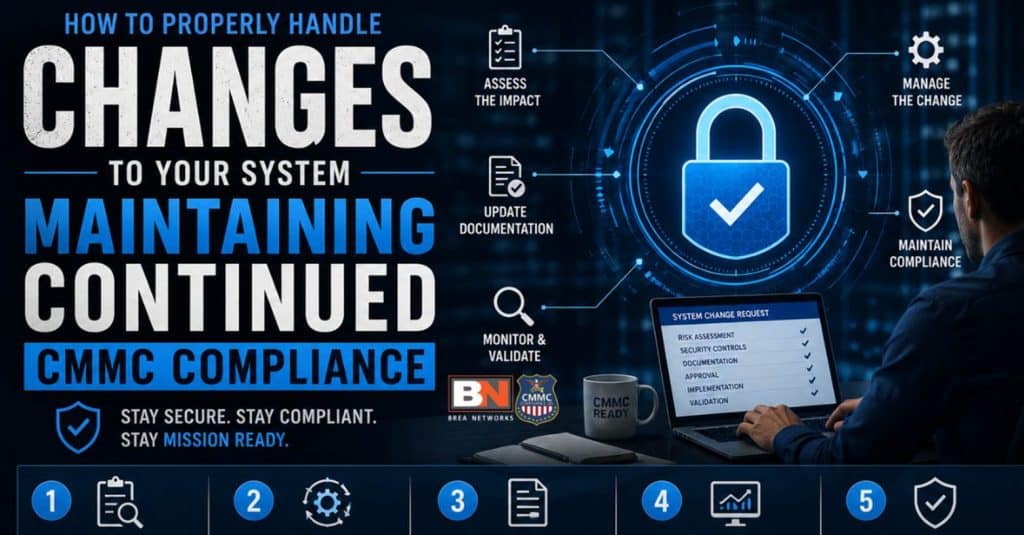
One of the biggest misconceptions about CMMC is that certification is a one-time event.
It is not.
CMMC compliance must be maintained continuously after certification is achieved. For Level 2 and Level 3, organizations are also required to complete annual affirmations of continued compliance in SPRS. Under 32 CFR § 170.22, that affirmation is a legally significant representation made by a senior company official that the organization continues to meet all requirements within its CMMC Assessment Scope.
That means significant system changes, infrastructure updates, software deployments, vendor integrations, or network modifications can affect your compliance posture if they impact systems that process, store, or transmit FCI or CUI.
For defense contractors handling Controlled Unclassified Information, poorly managed changes can create security gaps that affect both contract eligibility and assessment readiness.
The companies that stay compliant are not the ones that avoid change. They are the ones who manage change correctly.
Why System Changes Matter Under CMMC
Every security control in your environment depends on the systems, configurations, policies, and processes currently in place.
When systems that are part of the CMMC Assessment Scope change, your security posture may change with them. Under 32 CFR § 170.19, the CMMC Assessment Scope defines which assets within your environment are assessed against the security requirements. Changes that alter what falls inside that boundary require evaluation before implementation.
Changes such as adding a new cloud application, migrating email systems, deploying remote access tools, replacing firewalls, changing vendors or External Service Providers, adding privileged users or administrators, expanding your network, or moving systems into Azure Government or GCC High can impact CMMC scope boundaries, logging and monitoring, access controls, multifactor authentication, encryption protections, SSP accuracy, vendor responsibilities, and inherited cloud controls.
If those changes are not evaluated properly, your organization may no longer meet the security requirements it was originally assessed against.
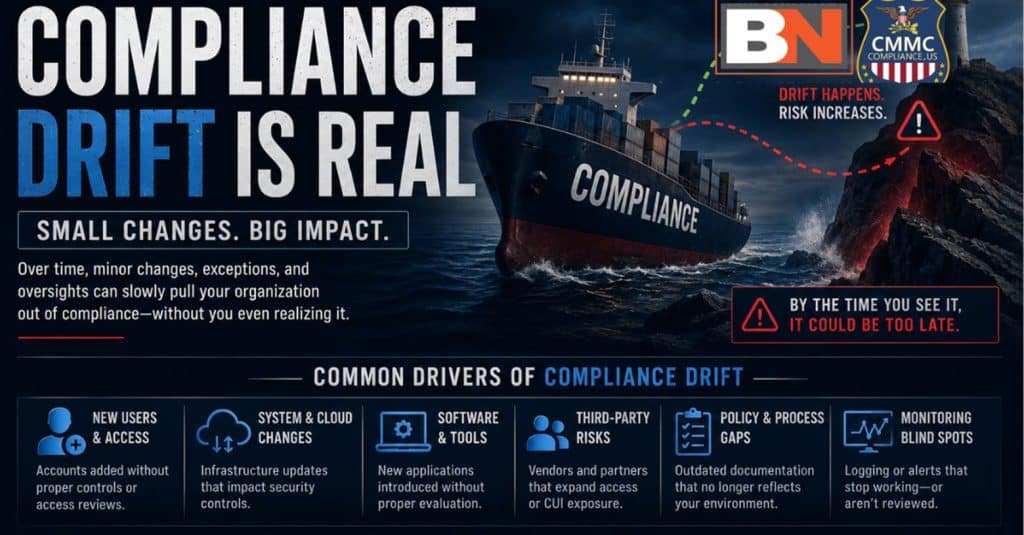
Compliance Drift Is Real
Many organizations pass assessments and then slowly drift out of compliance over time. Not because they intended to ignore security requirements, but because operational changes happened faster than compliance oversight.
This is one of the most significant risks in ongoing CMMC maintenance, and it is exactly the kind of gap that a DCMA DIBCAC audit, which can occur at any time under 32 CFR § 170.16, is designed to surface.
Examples include a new application deployed without documentation updates, an administrator creating a temporary exception that never gets removed, a vendor receiving access without proper controls, logging stopping after a system migration, a remote employee beginning to handle CUI outside the approved enclave, security settings changing without a security impact analysis, or an SSP that no longer reflects the actual environment.
Individually, these changes may seem small. Together, they can create serious assessment and legal problems. Under the DoW’s Civil Cyber-Fraud Initiative, the Department of Justice has pursued False Claims Act cases where the gap between a contractor’s compliance representations and their actual security posture was material. An annual affirmation submitted while the environment has drifted is a representation of the facts that may no longer be supported.
The Importance of Formal Change Management
Proper change management is one of the most important operational disciplines for maintaining CMMC compliance.
CMMC Level 2 specifically includes security requirements for Configuration Management that address this directly. Requirement 3.4.3 addresses the management of and control over changes to organizational systems, and Requirement 3.4.4 requires security impact analysis of changes to organizational systems. Both are part of the 110 security requirements in NIST SP 800-171 Revision 2 that a C3PAO will evaluate during a Level 2 certification assessment under 32 CFR § 170.17.
Before making significant changes to scoped systems or environments, organizations should evaluate whether the change affects CUI scope, whether security controls are impacted, whether documentation requires updates, whether access permissions need adjustment, whether new risks are introduced, whether monitoring and logging remain intact, whether inherited cloud or ESP controls change, and whether additional evidence should be collected.
Changes should be reviewed before implementation, not after problems appear. This process helps prevent security gaps from becoming compliance failures.
Your Documentation Must Evolve With Your Environment
One of the fastest ways organizations fall out of compliance is with outdated documentation.
Your System Security Plan must reflect your actual environment. NIST SP 800-171 requires organizations to develop, document, and periodically update system security plans that describe system boundaries, operating environments, implemented security requirements, and system relationships.
If your infrastructure changes but your SSP still describes the old environment, assessors will identify the mismatch. The DoW CIO CMMC Assessment Guide Level 2 makes clear that assessors evaluate whether controls are implemented correctly, operating as intended, and producing the desired security outcome, not merely whether documentation once described a compliant state.
The same documentation obligation applies to network diagrams, data flow diagrams, asset inventories, policies and procedures, incident response documentation, access control records, vendor inventories, and evidence libraries. If the environment changes, the documentation must change with it.

Not sure where your organization stands with CMMC, ITAR, or federal cybersecurity requirements? The fastest way to get clarity is to talk with an expert. Book a call with our team to review your current environment, identify compliance risks, and understand what steps are required to move forward. A short conversation can help you avoid costly mistakes and focus on what matters for contract eligibility and security.
SCHEDULE YOUR FREE CONSULTATION!
Assessors Look for Operational Consistency
C3PAOs do not evaluate whether controls existed at one point in time. Under the assessment methodology described in the DoW CIO CMMC Assessment Guide Level 2, assessors use examine, interview, and test methods to evaluate whether each of the 320 assessment objectives is demonstrably met across all assets within the CMMC Assessment Scope defined under 32 CFR § 170.19.
That means organizations must demonstrate that compliance is part of ongoing operations, not a temporary project created for assessment day. Mature organizations build compliance into daily operational processes by tracking changes, documenting decisions, performing security impact analysis, reviewing scope changes, maintaining evidence, and validating control effectiveness after major changes.
Common High-Risk Changes Contractors Overlook
Certain changes create larger compliance risks than others.
Cloud migrations often affect identity management, logging, data residency, inherited controls, and shared responsibility boundaries. If your organization uses a cloud service provider to process, store, or transmit CUI, DFARS 252.204-7012 requires that provider to meet security requirements equivalent to the FedRAMP Moderate baseline at a minimum. Changing cloud providers or environments without verifying that the requirement is met is a compliance gap from the moment the change takes effect.
Mergers or acquisitions can dramatically expand CUI scope, potentially pulling systems, users, and data flows into the CMMC Assessment Scope that were never previously evaluated.
Remote work deployments frequently introduce access control issues, endpoint management gaps, shadow IT risks, and improper CUI handling outside approved enclaves.
New vendors may become External Service Providers or Cloud Service Providers whose security posture affects your assessment scope under the DoW CIO CMMC Scoping Guide Level 2. Not every vendor is an ESP but determining which ones are requires a documented evaluation before access is granted.
Even replacing core infrastructure like firewalls, SIEM platforms, MFA solutions, or endpoint protection systems can affect evidence collection and monitoring continuity if the transition is not managed with compliance documentation in mind.
The risk is not the change itself. The risk is failing to evaluate the compliance impact before making the change.
The POA&M Dimension of Change Management
Changes that introduce new gaps after certification create a specific compliance problem under 32 CFR § 170.21. A Plan of Action and Milestones is a tool for managing known gaps at the time of assessment it is not a mechanism for managing ongoing compliance drift after certification is issued.
If a post-certification change introduces a gap in a control that was previously assessed as MET, that gap is not automatically covered by any existing POA&M. It is a change in the organization’s compliance posture that may affect the accuracy of the annual affirmation submitted to SPRS. Organizations that accumulate undocumented post-certification gaps and continue affirming compliance annually without addressing them are creating exactly the kind of exposure the DoW’s Civil Cyber-Fraud Initiative is designed to pursue.
Compliance Is a Continuous Process
The organizations that succeed with CMMC long-term understand something important. Certification is not the end of the process.
Maintaining compliance requires ongoing oversight, technical discipline, documentation management, security governance, regular review of scoped systems, and annual affirmations of compliance under 32 CFR § 170.22. That becomes even more important as the DoW continues evolving cybersecurity expectations through updated frameworks, revised NIST standards, and future rulemaking tracked at regulations.gov.
Level 2 certification is valid for three years. But it is valid for three years only if the organization continues to meet the security requirements within the assessed scope. An environment that has materially changed since the assessment date, without documented change management and updated evidence, is not the environment the certificate reflects.
Your environment will change. Your business will grow. New technologies will be deployed. The question is not whether change will happen. The question is whether your organization can manage that change without breaking compliance.
The contractors that build strong change management processes now, anchored in the requirements at 32 CFR Part 170 and the security requirements in NIST SP 800-171 Revision 2, will be the ones that remain compliant, assessment-ready, and contract-eligible long after certification is complete.

If your organization supports defense contracts and is unsure how CMMC timelines, SPRS requirements, or assessment readiness apply to you, now is the time to get clarity.
About Brea Networks
Brea Networks is a cybersecurity and compliance-focused IT partner dedicated to supporting Defense Industrial Base (DIB) contractors. We help organizations understand and implement the security requirements outlined in FAR 52.204-21, DFARS 252.204-7012, and the CMMC framework. From Level 1 self-assessments to Level 2 readiness and certification preparation, our team works alongside contractors to strengthen system security, define scope, prepare documentation, and build sustainable compliance programs that protect FCI and CUI.