
ITAR vs EAR: What Defense Contractors Need to Know
ITAR vs EAR: Key Differences Every Defense Contractor Must Understand
Many companies in the defense supply chain struggle to understand whether their products, data, or services fall under ITAR (International Traffic in Arms Regulations) or EAR (Export Administration Regulations).
This confusion can create serious compliance risks.
Misclassifying controlled technologies can lead to unauthorized exports, regulatory violations, and potential penalties. For defense contractors, understanding the difference between ITAR and EAR is essential to protecting sensitive information and maintaining eligibility for government contracts.
What Is ITAR
ITAR regulates defense articles, technical data, and defense services that are critical to U.S. national security.
These items are listed on the USML and are strictly controlled by the U.S. Department of State.
ITAR focuses on:
• Military systems and components
• Weapons and defense equipment
• Defense-related technical data
• Defense services and engineering support
ITAR places strict limits on who can access this information, especially when it involves foreign nationals or international transfers.
What Is EAR
EAR governs dual-use items, which are technologies that have both commercial and military applications.
These items are listed on the Commerce Control List (CCL) and are regulated by the U.S. Department of Commerce.
EAR applies to:
• Commercial technologies with potential military use
• Software and electronics
• Telecommunications systems
• Industrial equipment and components
Compared to ITAR, EAR is generally more flexible but still requires careful classification and control.

ITAR vs EAR: The Key Differences
Understanding how these regulations differ is critical for compliance.
Regulatory Authority
• ITAR → U.S. Department of State
• EAR → U.S. Department of Commerce
Type of Items Controlled
• ITAR → Defense-specific items (USML)
• EAR → Dual-use and commercial items (CCL)
Level of Restriction
• ITAR → Strict control, limited access
• EAR → Varies based on classification and destination

Not sure where your organization stands with CMMC, ITAR, or federal cybersecurity requirements? The fastest way to get clarity is to talk with an expert. Book a call with our team to review your current environment, identify compliance risks, and understand what steps are required to move forward. A short conversation can help you avoid costly mistakes and focus on what matters for contract eligibility and security.
SCHEDULE YOUR FREE CONSULTATION!
Access to Data
• ITAR → Highly restricted, especially for foreign nationals
• EAR → Controlled, but often allows more flexibility depending on classification
Why Misclassification Creates Risk
One of the most common compliance failures is incorrectly classifying technologies under ITAR or EAR.
Examples of risk include:
• Treating ITAR-controlled data as EAR-controlled
• Sharing technical data with unauthorized foreign nationals
• Storing controlled data in unapproved environments
• Failing to apply proper export licensing requirements
Even unintentional mistakes can result in violations, audits, and contract issues.
Where Companies Get It Wrong
Many organizations assume:
“We are not a defense contractor, so ITAR does not apply.”
This is often incorrect.
Companies can fall under ITAR or EAR if they:
• Support defense programs
• Manufacture components used in defense systems
• Provide engineering or technical services
• Handle CTI
Even subcontractors and vendors can be subject to export control requirements.
How to Determine Whether ITAR or EAR Applies
Organizations must evaluate their technologies, data, and services to determine the correct classification.
Key steps include:
• Identifying products and technical data
• Reviewing the U.S. Munitions List (USML)
• Reviewing the Commerce Control List (CCL)
• Determining how the technology is used
• Assessing access by foreign nationals
Proper classification is the foundation of an effective compliance program.
The Role of Internal Controls
Regardless of whether ITAR or EAR applies, organizations must implement strong internal controls.
This includes:
• Restricting access to controlled data
• Monitoring data sharing and collaboration tools
• Managing foreign national access
• Documenting compliance procedures
• Training employees on export control requirements
Without these controls, companies risk unauthorized exports and compliance failures.
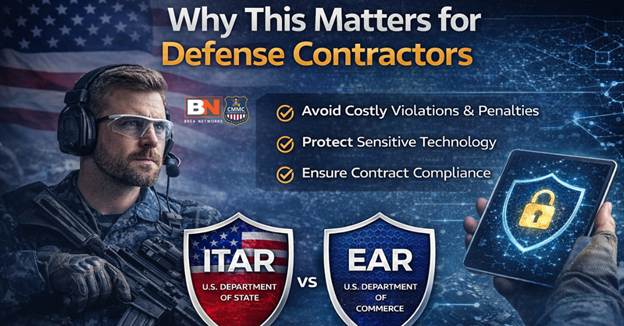
Why This Matters for Defense Contractors
Export control compliance is becoming a critical requirement across the Defense Industrial Base.
Prime contractors and government agencies expect vendors to:
• Understand whether ITAR or EAR applies
• Protect controlled technical data
• Maintain compliance documentation
• Reduce export control risks
Failure to do so can impact:
• Contract eligibility
• Vendor relationships
• Regulatory standing
Understanding the difference between ITAR and EAR is essential for any organization working with defense technologies or supporting the defense supply chain.
ITAR applies to strictly controlled defense-related items, while EAR governs dual-use technologies with both commercial and military applications.
Misclassification and weak internal controls are common causes of export control violations.
Organizations that take the time to properly classify their technologies and implement strong compliance programs are better positioned to reduce risk and maintain eligibility for defense contracts.
If your organization is unsure whether your technologies fall under ITAR or EAR, it is important to identify risks early.
About Brea Networks
Brea Networks is a cybersecurity and compliance-focused IT partner dedicated to supporting Defense Industrial Base (DIB) contractors. We help organizations understand and implement the security requirements outlined in FAR 52.204-21, DFARS 252.204-7012, and the CMMC framework — from Level 1 self-assessments to Level 2 and Level 3 readiness. Our team works alongside contractors to strengthen system security, define assessment scope, prepare documentation such as System Security Plans (SSPs) and POA&Ms, and build sustainable cybersecurity programs that protect FCI and CUI. Whether you are preparing for a self-assessment, a C3PAO certification, or simply improving your security posture, Brea Networks provides practical guidance and technical expertise to help you move forward with confidence.
Brea Networks, LLC
451 W Lambert Rd Ste 214
Brea, CA 92821
https://www.cmmccompliance.us
https://www.breanetworks.com
Telephone: 714-592-0063