The Misconception That Creates Risk
There’s a common assumption across machine shops, aerospace suppliers, and defense subcontractors: if nothing is being exported, then ITAR doesn’t apply. It feels logical. If your business only operates within the United States, sells to domestic customers, and never ships internationally, export regulations shouldn’t be a concern.
That thinking is exactly what creates risk. Many companies that believe they are outside the scope of ITAR are, in reality, already subject to it. The danger is not just noncompliance, but unintentional noncompliance. Companies often discover their exposure only after they have already been handling controlled items or data for months or even years.
https://www.pmddtc.state.gov/ddtc_public
ITAR Is About Control, Not Just Exporting
ITAR, enforced by the U.S. Department of State’s Directorate of Defense Trade Controls, is built around controlling access to defense-related items and information. Exporting is only one part of that system.
The regulations are designed to prevent sensitive military technologies from being accessed by unauthorized individuals or countries. Because of that, ITAR applies to manufacturing, handling, storing, and sharing defense articles and technical data, regardless of whether those items ever leave the country.
This means a company can be fully subject to ITAR without ever engaging in what it considers an export.
https://www.ecfr.gov/current/title-22/chapter-I/subchapter-M
Manufacturing Alone Can Bring You Into Scope
If your company manufactures a part that falls under the U.S. Munitions List, ITAR obligations can begin immediately. It does not matter whether the component is large or small, complex or simple. If it is designated as a defense article, the act of producing it is enough to bring your business into a regulated environment.
This is especially common in aerospace and defense supply chains where smaller machine shops produce components that are later integrated into larger systems. Even if you never see the final product, your role in producing a controlled item is enough to trigger ITAR considerations.
https://www.ecfr.gov/current/title-22/chapter-I/subchapter-M/part-121
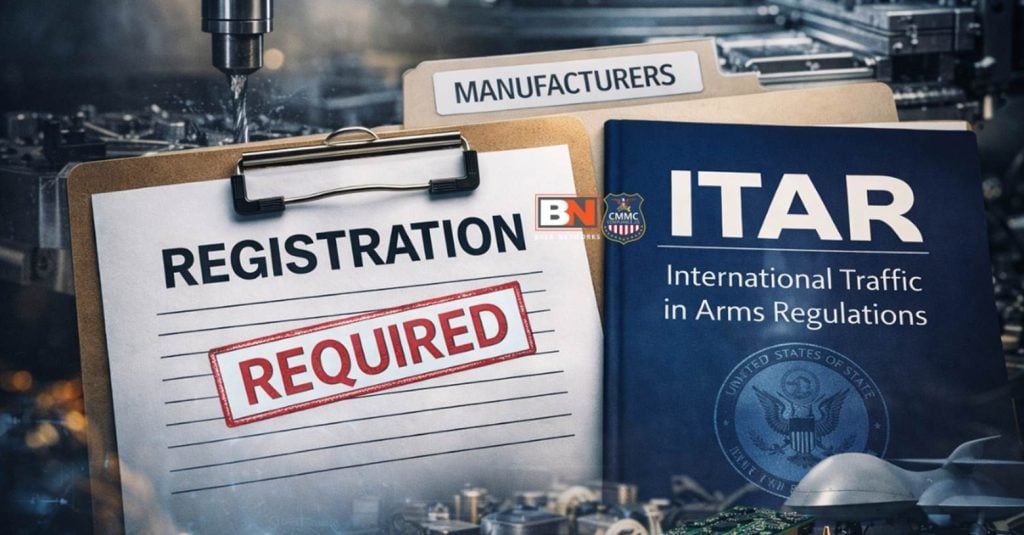
Registration Is Not Optional for Manufacturers
One of the biggest surprises for domestic-only companies is the requirement to register with DDTC. Many assume registration is only necessary if they export, but the regulation clearly ties registration to manufacturing defense articles.
If your business is engaged in manufacturing items on the U.S. Munitions List, registration may be required regardless of whether you export. This requirement exists because the government needs visibility into who is producing controlled items, not just who is shipping them.
Failing to register does not mean you are outside ITAR. It means you may already be out of compliance.
https://www.ecfr.gov/current/title-22/chapter-I/subchapter-M/part-122/section-122.1
Technical Data Is Where Many Companies Get Exposed
Physical parts are only one side of ITAR. The other, often more sensitive side, is technical data. This includes drawings, blueprints, CAD files, specifications, and any information required to manufacture or use a defense article.
Even if your company never designs anything and only machines parts based on customer-provided drawings, you are still handling controlled technical data. That alone brings compliance responsibilities related to storage, access, and transmission of that information.
Many companies underestimate how easily this data can be mishandled, especially in digital environments where files are shared, copied, and stored across multiple systems.
https://www.ecfr.gov/current/title-22/chapter-I/subchapter-M/part-120/section-120.10

Not sure where your organization stands with CMMC, ITAR, or federal cybersecurity requirements? The fastest way to get clarity is to talk with an expert. Book a call with our team to review your current environment, identify compliance risks, and understand what steps are required to move forward. A short conversation can help you avoid costly mistakes and focus on what matters for contract eligibility and security.
SCHEDULE YOUR FREE CONSULTATION!
The Hidden Risk of Deemed Exports
One of the least understood aspects of ITAR is the concept of a deemed export. Under the regulations, providing controlled technical data to a non-U.S. person is treated as an export, even if it happens entirely within the United States.
This creates risk in everyday situations. A foreign national employee accessing controlled drawings, a contractor reviewing specifications, or even remote system access from outside the country can all fall under this definition.
For many companies, this is the moment where they realize ITAR is not about shipping products. It is about controlling who can see and use certain information.
https://www.ecfr.gov/current/title-22/chapter-I/subchapter-M/part-120/section-120.17
Your Workforce and Systems Are Part of Compliance
For companies that do not export, the greatest exposure often exists internally. It is not the shipping department that creates risk, but the way information flows through the organization.
Who has access to controlled files, how those files are stored, and what systems are used to share them all play a role in compliance. Standard business tools like email, cloud storage, and collaboration platforms can create exposure if they are not configured with ITAR requirements in mind.
This is why companies that believe they are low risk often face the highest compliance gaps. The risk is not visible in their operations, but it is embedded in their processes.
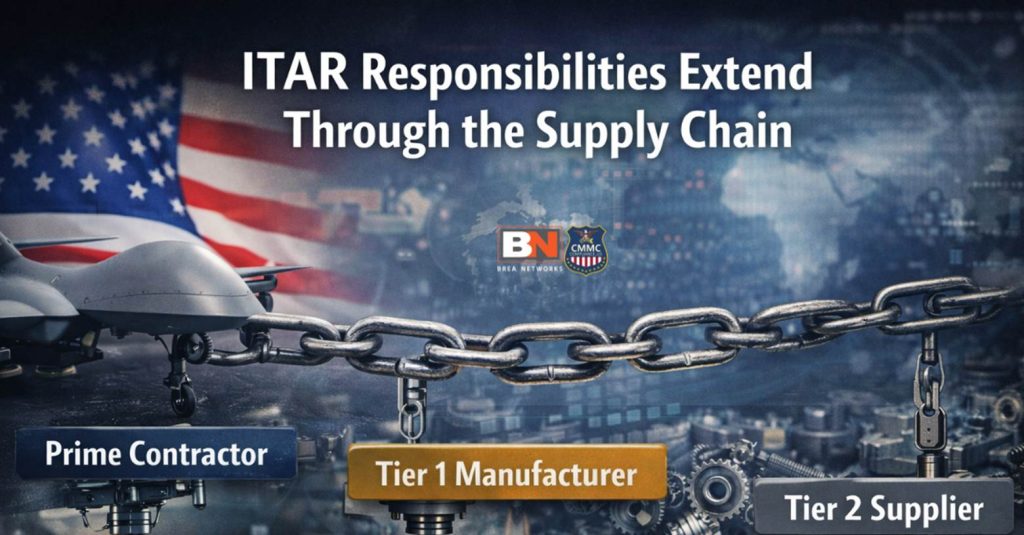
ITAR Responsibilities Extend Through the Supply Chain
Being a subcontractor does not reduce your responsibility under ITAR. The regulations follow the defense article and its associated data throughout the entire supply chain.
If you are manufacturing a controlled component, your company is part of that regulated chain, regardless of how far removed you are from the prime contractor. Compliance is not something that can be passed upstream or assumed to be handled by someone else.
Each company is responsible for its own role in protecting controlled items and information.
Why Many Companies Miss This Until It Is Too Late
The gap between perception and reality is what creates the biggest risk. Many companies operate under the assumption that they are unregulated because they do not export, while in practice they are working with controlled items every day.
This leads to common issues such as uncontrolled file sharing, lack of employee screening, and use of non-compliant storage systems. These are not intentional violations, but they are still violations.
Understanding jurisdiction is the first step toward closing this gap. Determining whether your products fall under ITAR or the Export Administration Regulations is critical, and the responsibility to make that determination sits with the company.
The Bottom Line
ITAR is not just about exporting. It is about controlling access to defense-related items and the information that supports them.
If your business manufactures defense parts or handles related technical data, ITAR can apply whether you export or not. The absence of exports does not remove your obligations. In many cases, it simply hides the risk.
For many companies, the real issue is not intentional noncompliance. It is not realizing they were subject to ITAR in the first place.

If your organization is unsure whether your technologies will fall under ITAR or EAR, it is important to identify risks early.
Download the ITAR Compliance Checklist to better understand how to protect controlled data and reduce export control exposure.
About Brea Networks
Brea Networks is a cybersecurity and compliance-focused IT partner dedicated to supporting Defense Industrial Base (DIB) contractors. We help organizations understand and implement the security requirements outlined in FAR 52.204-21, DFARS 252.204-7012, and the CMMC framework from Level 1 self-assessments to Level 2 and Level 3 readiness. Our team works alongside contractors to strengthen system security, define assessment scope, prepare documentation such as System Security Plans (SSPs) and POA&Ms, and build sustainable cybersecurity programs that protect FCI and CUI. Whether you are preparing for a self-assessment, a C3PAO certification, or simply improving your security posture, Brea Networks provides practical guidance and technical expertise to help you move forward with confidence.
Brea Networks, LLC
451 W Lambert Rd Ste 214
Brea, CA 92821
https://www.cmmccompliance.us
https://www.breanetworks.com
Telephone: 714-592-0063